The flesh that dreamed of screws
A salaryman runs down a metal fetishist and wakes to steel pushing through his skin. Across 67 minutes of 16mm, Tsukamoto turns guilt, desire, and scrap into a sickness the flesh learns to want.
Tetsuo: The Iron Man makes metal contagious only because guilt and desire have already prepared the body to receive it. Shinya Tsukamoto begins with a metal fetishist who cuts open his thigh, inserts a steel pipe, runs in panic, and is struck by a salaryman's car. The route from that collision to the salaryman's mutation is anything but orderly. Later fragments return to the crash: the couple leave the injured man in the grass and have sex near his body. When the salaryman shaves and finds a thorn, a sliver of steel, emerging from his cheek, the film brings back its original violence as guilt that was never buried.
That broken chronology rules out an easy medical or moral diagnosis. The transformation is not a literal infection explained by the plot; it can be read as contagion, a bodily form taken by touch, abandonment, and sex. Tsukamoto plays the fetishist, Tomorowo Taguchi the salaryman, and Kei Fujiwara his girlfriend. Editing pulls those three bodies toward one another until blame seems to have changed hosts. Steel does not punish an ordinary man for a settled crime. It exposes something the film imagines as already waiting inside him.
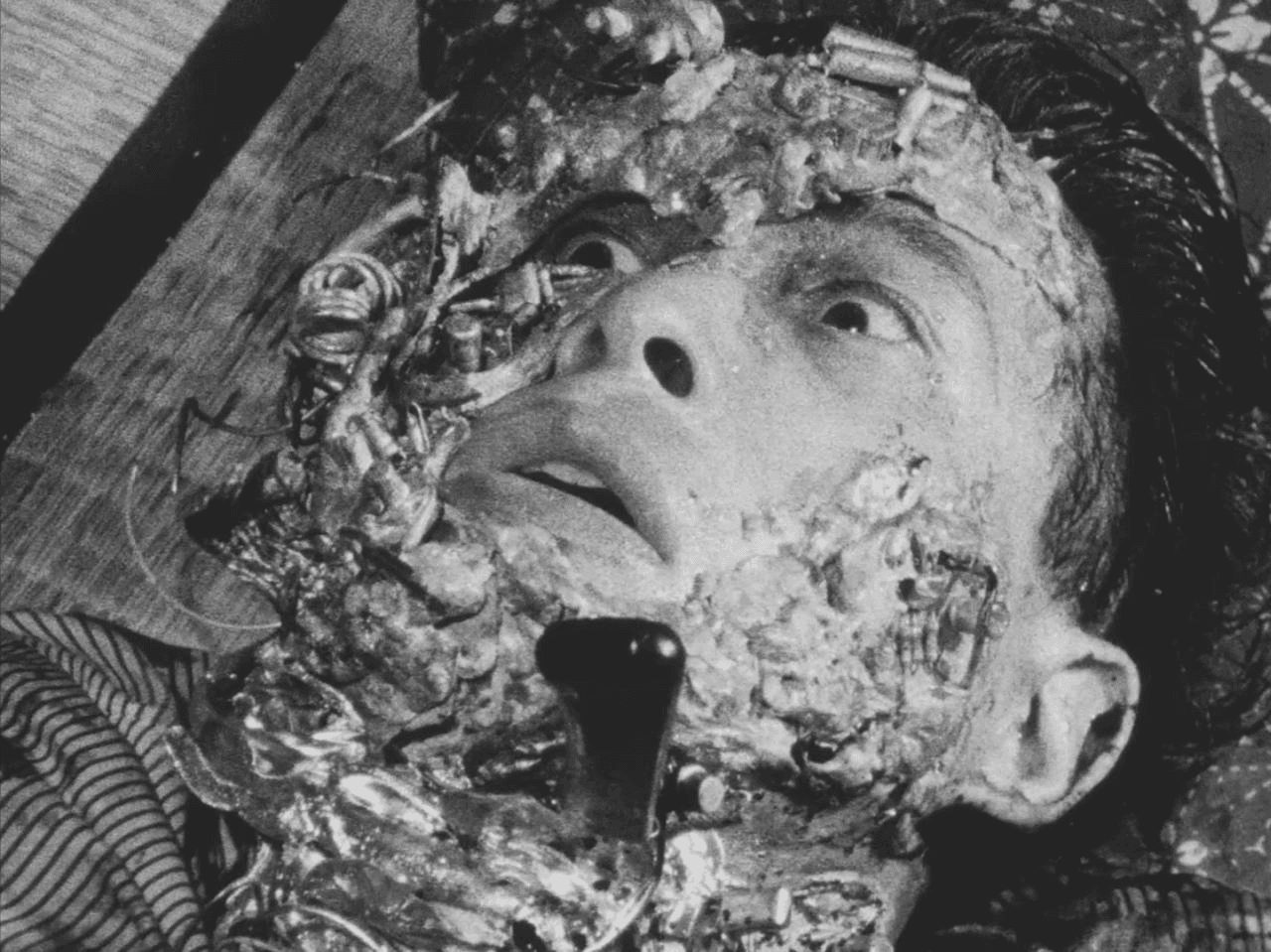
Look at the still above. This is a face at the precise point where it is ceasing to be one. The screws do not sit on the skin; they seem forced out from within, steel pimples the flesh has produced without consent. The harsh black-and-white 16mm turns each protrusion into a slash of light against the dark, while the thick grain makes the image look nearly as corroded as the man. His eyes remain human and frightened, trapped in a face beginning to belong to a machine. The still's horror is not its prop work. It is the consciousness that survives the change and has to witness its own body become another species.
Metal as venereal disease
Calling metal a venereal disease is a critical reading, not Tetsuo's hidden clinical diagnosis. It names the way the film knots together eroticism, injury, and punishment without allowing them to come apart. Tsukamoto has spoken of erotic intention, and the movie makes that intention abrasive. The drill that erupts from the salaryman's groin is not a lone phallic gag; it turns arousal into a mechanism that can pierce whoever stands nearby. His girlfriend is caught in the same spiral, stabs the salaryman in the neck and, in the final confrontation, is fatally impaled on the drill. The film gives no grounds for treating that death as a voluntary choice.
Metal does not enter the man from outside. It was already there, waiting; all that remained was for flesh to admit it had always wanted the screw.
Contagion therefore matters less as a plot mechanism than as an experience of proximity. Desire moves through the couple's guilt and scrambles who hurts, who suffers, and who wants. This is where Tetsuo meets Possession: in both films, love does not cleanse the body but produces matter that none of its makers can command. Tsukamoto denies us the stability of a closed allegory. Sex, disgust, and fear are made to share a single current, with no promise that we will leave it clean.
The machine made by hand
The film's formal violence comes from an independent, handmade production: a tiny crew worked over roughly eighteen months, often in Fujiwara's apartment. That history should not be reduced to a one-man triumph for Tsukamoto. Fujiwara, Taguchi, Chū Ishikawa, and the other collaborators are present in the object itself. Hand-built effects, stop-motion, and editing make the city seem assembled from the same material that cuts into its characters. Constraint becomes method. There is no real separation between the scrap filmed on screen and the means by which the film was made.
Ishikawa's industrial score does not politely accompany the images; it clamps down on them. Every burst of speed, splice, and stop-motion shove makes the salaryman seem like a part being forced into place. At last he merges with the fetishist. Their rage changes key and becomes a monstrous declaration of love as the two set out to turn the world into metal. The ending restores no one. It stages a wedding between enemies, replacing the couple with a two-bodied machine.
Why abutre this
Winning best film at Rome's Fantafestival in 1989 made Tetsuo easy to file under “Japanese cult cinema.” The label keeps the prestige and removes the danger: a tactile, noisy, sexually uneasy encounter becomes a catalog curiosity. Its short running time is no promise of lightness, either. Sixty-seven minutes is the exact duration of an attack that stops before spectators can turn its assault into routine.
To abutre Tetsuo is to return weight to this small, clamorous film without pretending it yields to a single key. Metal may be city, guilt, desire, or simply matter in revolt; each reading weakens when it calls itself a verdict. What remains is the image of flesh learning to want what destroys it, and the strange tenderness with which two creatures finally decide to rust the world together.