Divorce as exorcism
Żuławski filmed the end of his own marriage and, without meaning to, made the most honest film ever made about what happens to the body when love rots. Isabelle Adjani delivers a subway scene no one should be able to act.
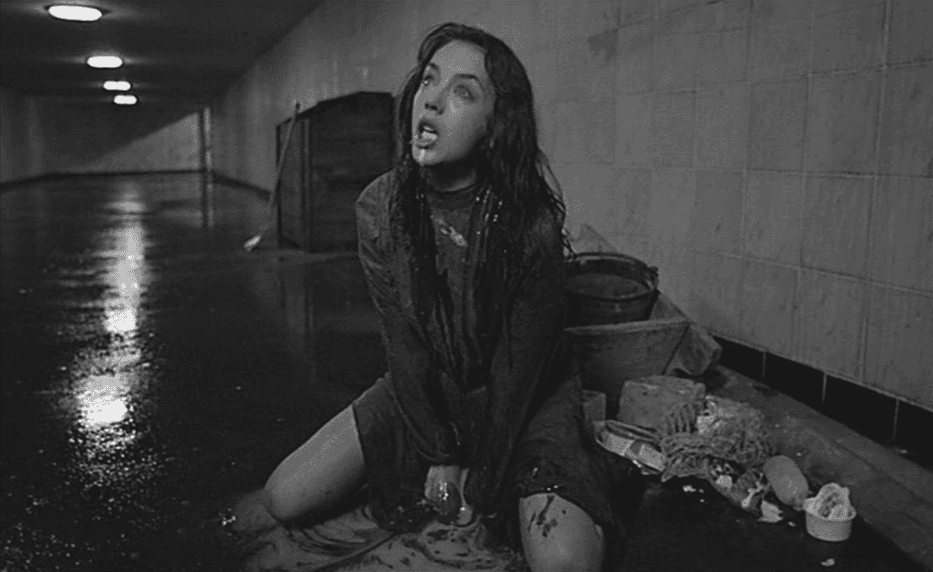
There are films about separation that weep. Possession convulses. Żuławski wrote the script during his own divorce, in Berlin, and what is on screen is not a representation of pain — it is pain barely contained inside a genre that cannot hold it. Begin with the plot and you get lost: a man returns from a work trip, discovers his wife wants to leave him, there is a lover, there is something else, there is a monster. End with the body and you understand everything.
The body is the subject. Anna (Isabelle Adjani) and Mark (Sam Neill) do not argue like people; they contort, hurl themselves against walls, gesticulate as if language had failed and only flesh remained. Żuławski directs actors the way one induces a breakdown. And then comes the subway scene — Adjani alone in an underground corridor, losing control of every muscle, laughing and crying and miscarrying something invisible onto the tiled floor. It is one of the most extreme acts of screen acting ever recorded. She won Cannes. She later said it took her years to recover.
The monster is literal because metaphor was not enough
At a certain point, Possession reveals that Anna keeps a creature in an empty apartment. A viscous, tentacled thing, designed by Carlo Rambaldi in the same year he was making Spielberg's E.T. The temptation is to read it as symbol — the new lover, desire, mental illness. Żuławski refuses the clean reading. The creature is literal because, for him, what happens in a divorce is also literal: you engender something monstrous out of the person you loved, and you copulate with it, and it takes the shape of what you wanted the other to be.
It is not a film about a marriage ending. It is a film about what grows in the void the marriage leaves behind.
Why abutre this
The critics of 1981 did not know what to do. The film was cut, classified as a video nasty in the United Kingdom, filed away as hysterical horror. It took four decades for Possession to be read as what it is: a document of emotional collapse filmed from inside the collapse. The hysteria that bothered the critics is the method. Żuławski is not exaggerating separation; he is refusing to domesticate it for your comfort.
To abutre Possession is to resist the urge to explain it. The film does not want to be decoded — it wants to be survived. Watch it once and you will want to rationalize. Watch it twice and you will realize Żuławski had already anticipated your defense, and filmed it as one more wall for a body to throw itself against.