The last thing Pasolini wanted us to see
Not a film about sadism. A film about what power does once it learns it can do anything — and Pasolini was murdered before the premiere, as if the work demanded the author's body in payment.
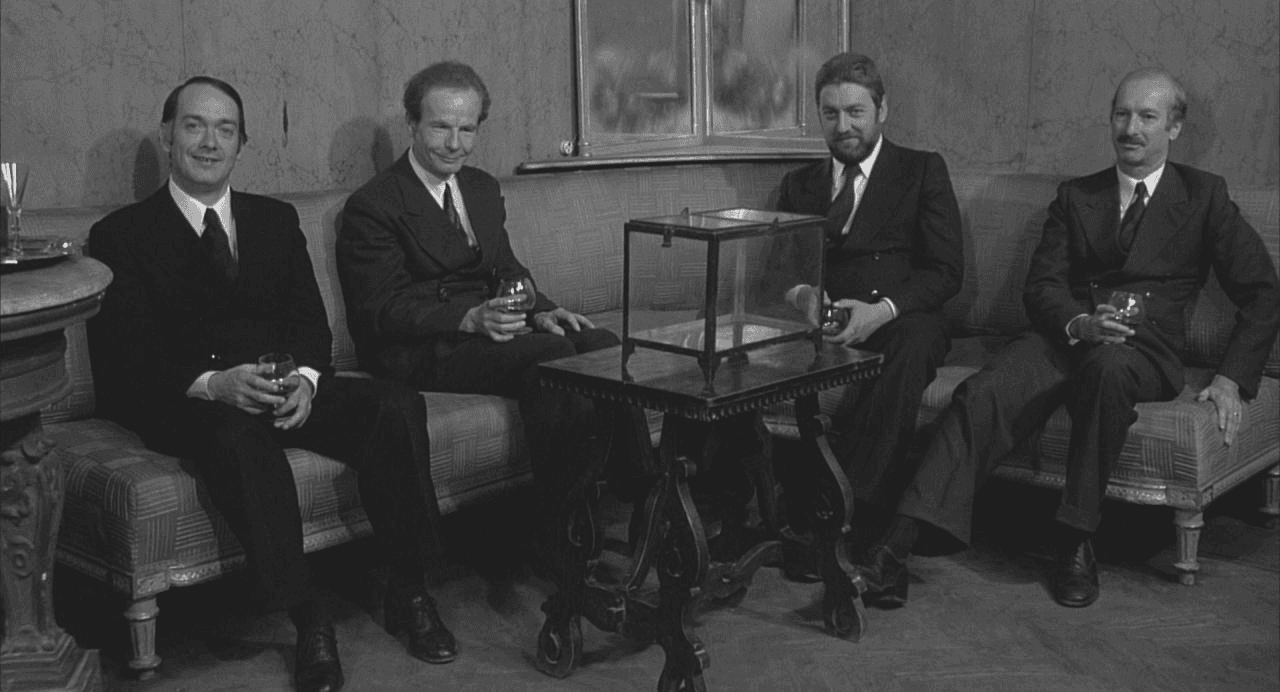
There is a comforting lie repeated about Salò: that it is unwatchable. The opposite is true. It is too watchable. What it makes unbearable is not the image — it is the clarity. Pasolini films degradation with the coldness of a treatise, in shots composed like Renaissance frescoes, and the horror is born precisely there: in the elegance with which power catalogues its victims.
The operation is simple, and therefore devastating. Sade wrote The 120 Days of Sodom as an encyclopedia of transgression, an endless machine of excess. Pasolini takes that text and anchors it to a place and a date: Salò, 1944, the final months of Italian fascism. Sade's abstract pornography becomes concrete history. Four libertines — a duke, a bishop, a magistrate, a president — abduct eighteen young people and subject them to a methodical regime of humiliation. There is no pleasure in what they do. There is administration.
The body as final commodity
What Salò understands, and almost no film about violence understands, is that extreme cruelty is not chaotic. It is bureaucratic. The torturers have rules, schedules, a master of ceremonies who narrates. The infamous coprophagy scene is not about scatology: it is about the reduction of the human to consumable matter, about a power that decides even what enters another's body. Pasolini, a Marxist, is saying something precise about late capitalism — the anarchy of a power that turns everything into product, flesh included.
Real power does not torture out of rage. It tortures out of boredom, and documents everything.
This is where the still above works against you. Look at the torturer, not the victim. The composure. The fascism of Salò does not wear the deformed face of the cinema monster; it wears the bored face of someone signing papers. Pasolini refuses the comfort of a villain we can hate from a distance. He films evil as function, not as character.
Why abutre this
Polite criticism filed Salò under "extreme," under provocation, under scandal — and in doing so, neutralized it. Calling a film shocking is a way of not thinking about it. But Pasolini did not want to shock; he wanted you to understand something about obedience, about how young bodies learn to collaborate in their own destruction because the alternative is to die sooner. There is a moment when the victims begin to inform on one another. That is the film. The rest is set design.
Pasolini was killed in November 1975, run over repeatedly by his own car on a beach in Ostia, weeks before the premiere. The investigation was never trustworthy. It is impossible to watch Salò today without that shadow: the man who filmed power taking the body to its last consequence had his own body destroyed before we could see him finish the sentence. The film remained as a testament, and a testament does not ask you to like it. It asks you to read it.