The mud has no end, and that is the point
Seven hours and nineteen minutes of rain, mud and waiting. Béla Tarr does not test your attention — he confiscates it, and charges interest. *Sátántangó* is the film in which time stops being a measure and becomes matter, something that clogs the screen the way water clogs the soil.
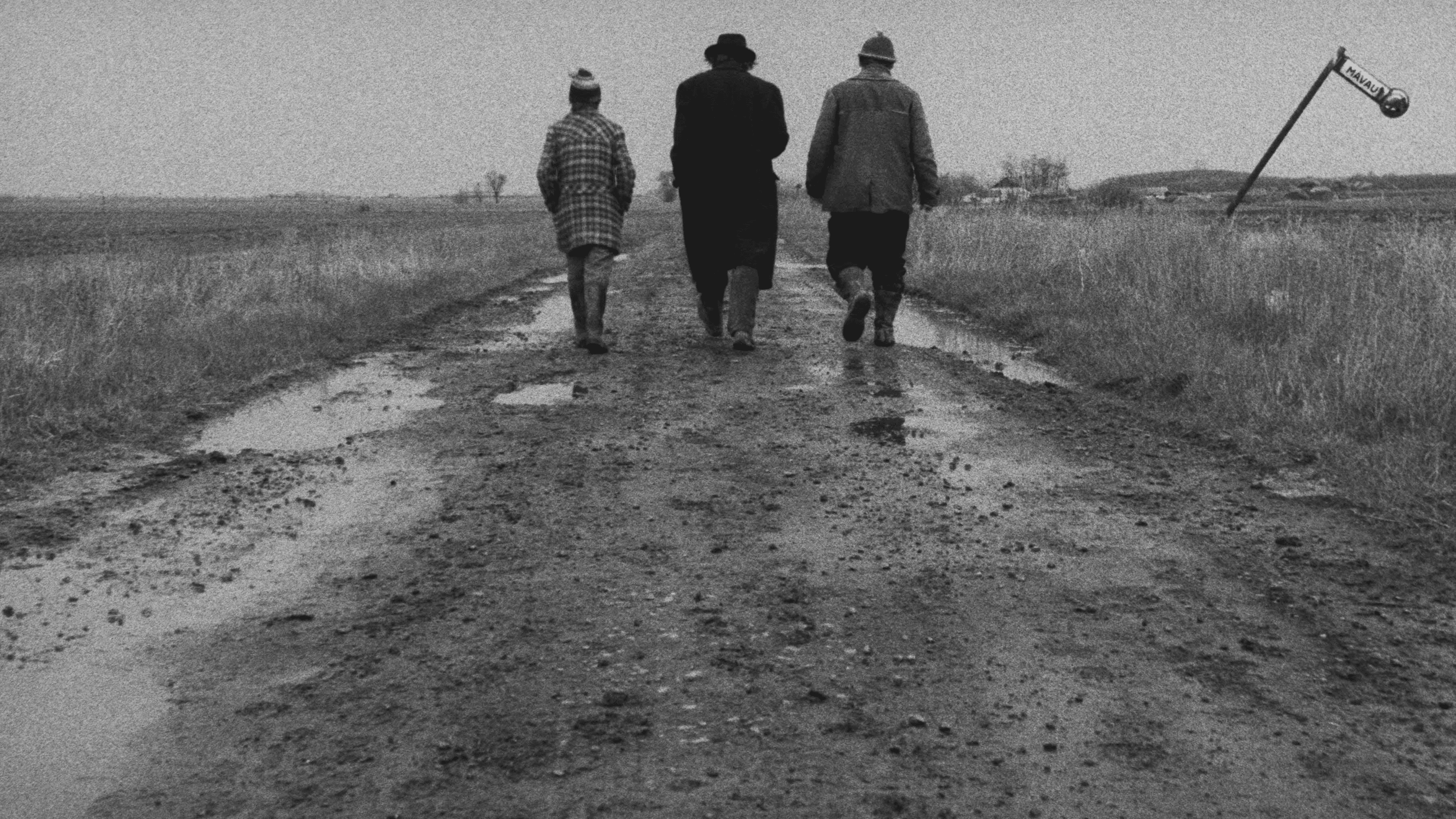
Four hundred and thirty-nine minutes. The film opens by spending eight of them on cows leaving a barn in the rain — unhurried, uncut, with no intention whatsoever of sparing you. Béla Tarr does not ask for patience the way one asks permission: he wrests it from you shot by shot, until the very notion of "how much is left" dissolves into the mud. There is no shortcut, no charitable ellipsis. Time here does not pass: it accumulates. Sátántangó does not last — it sediments.
The frame above is the entire thesis distilled. The muddy road, the bodies bent against the wind, the rain that does not fall — that simply is, as a permanent condition of the world. The camera follows the walk and refuses to cut. Look at what this specific image does: it takes from you the possibility of looking away with a clear conscience. Every meter of that road is covered in real time, with the wind pushing the extras as it pushes the camera, as it pushes you. It is not a representation of exhaustion; it is exhaustion, transferred from film to viewer through a single channel — duration. Tarr filmed the tiredness of those who walk, and the result is the tiredness of those who watch. The mimesis completes itself in your own body.
Duration as moral ordeal
To reduce Sátántangó to "slow cinema" is to betray it. Tarr's slowness is not one stylistic choice among others — it is the theme disguised as form. The collapsing collective farm, the waterlogged post-communism, the residents waiting for money that may never come: all of it is about people trapped in time, people for whom the future has been cancelled and only the unbearable thickness of the present remains. When Irimiás returns as a false messiah and manipulates them with the promise of a tomorrow, he is selling exactly what the film denies you — acceleration, meaning, destiny. The community believes because it can no longer bear duration. And you, in your seat, understand the temptation with your body, not your head.
The Estike episode is where the ordeal becomes obscene. The girl, isolated, exercises on the cat the only form of power she knows — cruelty — and then poisons herself. Tarr accelerates nothing. The animal's death and the child's death happen in the same slow, merciless time as everything else, without the courtesy of a score to tell you what to feel. Mihály Vig lays down the accordion like someone driving a nail, and the drunken dance in the tavern spins to the point of nausea. The structure imitates the tango: six steps forward, six steps back. Moving forward is an illusion. You always return to the mud.
The patience the film demands is not a cinephile's virtue — it is the same resignation the characters feel before a world that does not move, and Tarr wants you to feel it in the flesh before you judge them.
The mud that rewards those who linger in it
Polite criticism files Sátántangó away as a monument — something to be revered from a distance, cited, never watched whole. It is the most educated way of not facing it. They say "hard", "demanding", "for the initiated", and move on, clean. But the film only exists for those who get dirty. To abutre Sátántangó is to refuse the summary, the YouTube clip, the second-hand admiration: it is to surrender the seven hours and let time accumulate inside you, because only in accumulation does it reveal what it holds. Béla Tarr died in January 2026, and the most uncomfortable legacy he left is this: proof that duration can be a moral argument, that looking too long is a form of honesty. What criticism discards as "too long" is precisely the carrion — dense, slow, nourishing — that rewards the stomach of those who linger. Eat slowly. There is no other way.