Two faces, one mouth
An actress stops speaking. A nurse fills the silence until her own voice no longer feels like hers. Bergman shows the projector, tears the image apart, and stitches two faces together: identity is not revealed; it is manufactured.
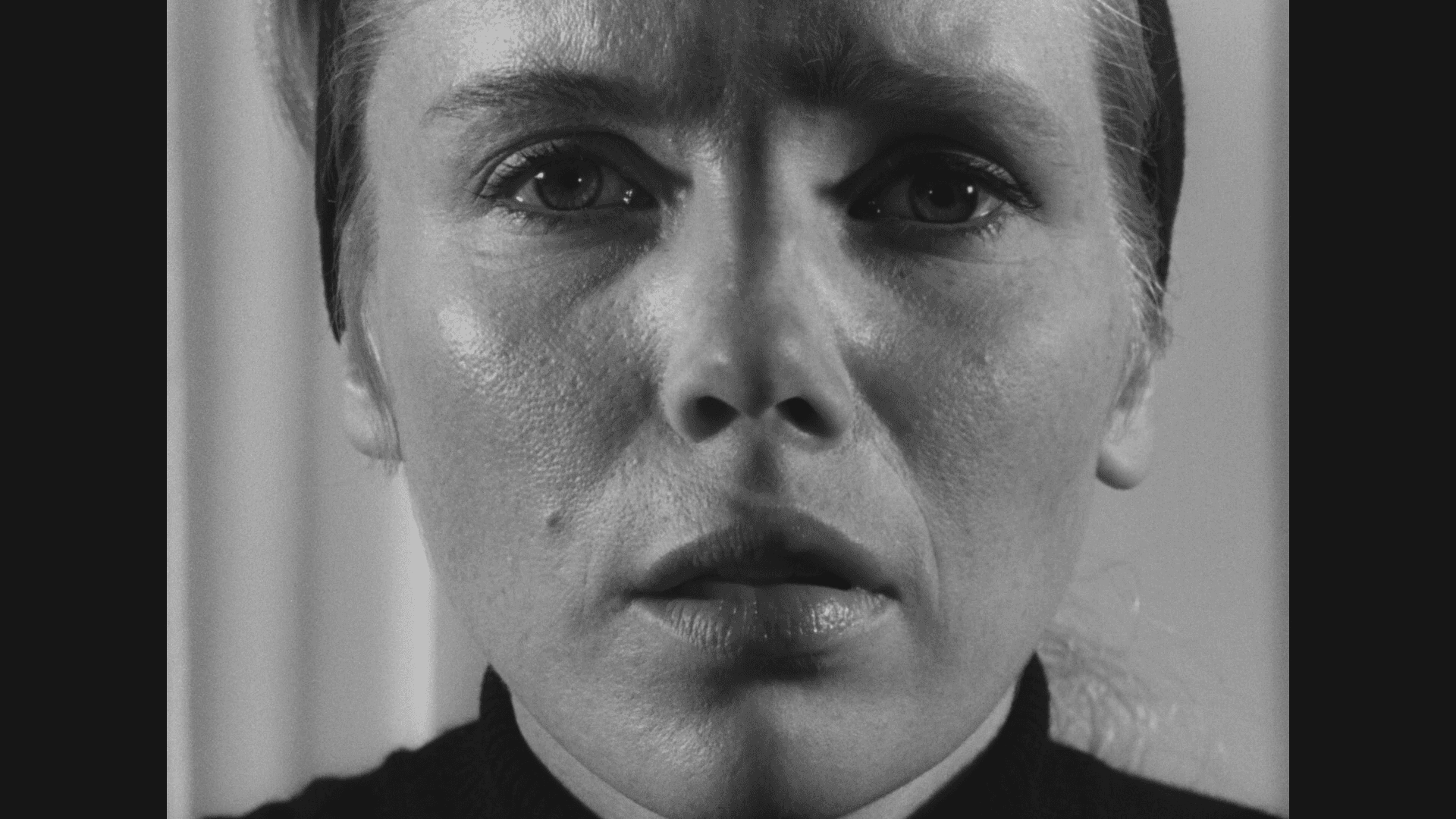
Persona does not begin with a face but with a machine. In the dark, the carbon rods of an arc lamp draw together and the projector wakes. Film runs. Before there is a story, Bergman cuts together a silent comedy, a nail driven through a hand, bodies in a morgue, and a boy touching the blur of a woman's face. He neither hides the apparatus nor asks the viewer to forget it. He says at once: what you are about to see is organized light, fragments taken from different places and stitched into sequence. After confessing the trick, he captures you anyway.
This is not a modernist ornament pasted in front of the film. It is the whole method. A mask does not become harmless when we see the strings that hold it; an image does not stop hurting because we know the machine that makes it. Persona exposes cinema in order to measure how much we still believe in a projected face. The question is not whether the illusion is true. It is what the illusion can do to us while we know it is not.
Silence as a form of possession
Elisabet Vogler, an actress, stops speaking during a performance of Electra. No injury accounts for the silence, which takes the shape of a refusal without submitting to diagnosis. Alma, the nurse assigned to her, accompanies her to a house by the sea. There, one mouth closes and the other begins to work for both of them. Alma fills the rooms with words, tells stories, confesses; Elisabet listens without giving her a word in return.
It is easy to mistake this arrangement for intimacy. Alma does. Faced with someone who neither interrupts nor judges aloud, she bares more of herself than she would in conversation. She speaks of the encounter on the beach, the abortion, pleasure and guilt. But the current moves in one direction. Elisabet preserves the right not to expose herself while receiving the other woman's life. When Alma reads the letter in which the actress describes her and turns her confessions into an object of observation, the silence changes weight: it was never neutral space, but a relation of power.
Bergman does not make Elisabet a monster or Alma a simple victim. Alma's speech also lays siege: it demands an answer, invents proximity, tries to force the other woman into a role. Each wounds with the instrument she has. One withdraws her voice; the other multiplies hers until speaking begins to resemble invasion. Silence, here, does not disclose an authentic self beneath convention. It is a mask as active as an actress's face.
Elisabet's silence does not hold a purer truth: it is the mask that forces Alma to strip bare for both of them.
When the surface tears
At a certain point, the image gives way. The film appears to jam, tear, and burn in the projector beam. The movie interrupts the women to show the surface that had been holding them. This is not a wink that cancels what we have seen. It is the opposite: Bergman destroys the medium for an instant and discovers that the relationship still weighs on us when projection resumes. Knowing that Alma and Elisabet are light does not make what they do to each other hurt less.
From then on, skin, film, and identity become hard to separate. The close-ups are not searching for a hidden essence; they examine the face until it stops looking like evidence of a coherent person. A cheek may belong to one woman, the gaze to another, the voice circulate between them. Cinema can isolate, repeat, superimpose. It can take two actresses and manufacture a third presence that never existed before the camera.
The famous composite face — half Liv Ullmann, half Bibi Andersson — solves nothing. It does not prove that Elisabet and Alma are literally the same person, or that one is the other's dream. Those readings remain possible, but the image does something more disturbing: it produces before us the resemblance we are tempted to call truth. We see the seam and still search for an individual. The person was not discovered; she was edited into being.
Why abutre this
Persona has been treated as a monument of art cinema for so long that reverence risks becoming an anesthetic. The film is quoted, framed, handed over to theory — and its immediate violence is sidestepped: one woman talks until she no longer knows who owns her voice, while another turns silence into a means of control. Calling it a masterpiece is not enough. It may be the most elegant way not to face it.
The other refuge is explanation: decide that the two women are one, assign a meaning to every image, and close the film like a solved case. To abutre Persona is to refuse both comforts. Bergman offers no pure face beneath the mask; he shows the labor by which every face is composed, projected, and recognized. The machine is visible, the image appears to burn, fiction confesses that it is fiction. Still, when two halves form a single mouth, we keep looking for someone who might speak.